
Earlier this month, Steam released a new game distributor’s guide prohibiting the publication of content that “may violate” the rules of providers of payment channels such as Visa and Mastercard, which resulted in dozens of adult games being mounted on the platform. Subsequently, the world’s largest stand-alone game platform also set up a wide range of content with adult (NSFW) elements, including visual novels and animations, and an unknown number of normal games suffered “mistakeful” undercarriage.
Following the outbreak of the adult game, the Australian feminist organization “Collective Shot” claimed responsibility for the incident, stating that they were pressured directly by the payment processor to take action in the absence of any response from Steam in its repeated protests. While many of the games removed are controversial, often depicting sensitive content, such as bad faith and slavery, and direct adult visual fiction, players fear that the precedent created by this may lead to even more critical scrutiny in the future. Because “Collective Shut” had previously used pressure on Detroit: The Transformer to depict child abuse. There had also been opposition to GTA 5, which allowed players to kill female NPCs.
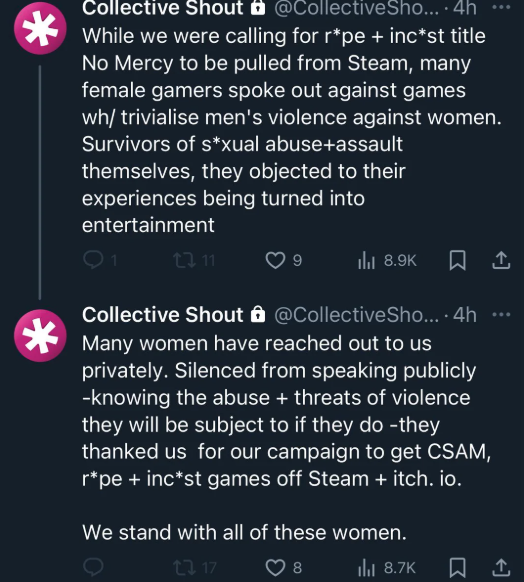
There are also concerns that LGBTQ+ games will also be marked as “adult” content and targeted. Since then, fans have launched a petition directly to the payment processors in the hope that future cleansing operations will be prevented.
It is worth mentioning that, well before Steam’s revised guidelines, United States Senator Kevin Cramer submitted to Congress on 4 February this year a bill aimed at imposing restrictions on “some networks of banks, credit unions and payment cards that refuse to cooperate with law-abiding individuals”.
Itch.io has recently updated its frequently asked questions, listing the elements that could lead to a game going down from its store, including special interests such as a variety of faeces. These elements are not per se illegal but are controversial.
If the bill is passed, it will “protect legitimate business activities from bank obstruction, thus avoiding the use of banks to achieve certain political objectives”. In other words, as long as the developer ‘ s game is legal, the payer will no longer have the right to refuse to provide it. This means that companies like Visa and Mastercard will no longer be able to press political entities for adult games under platforms such as Steam and Itch.
This may even cover the controversial games mentioned above, since Kramer noted, inter alia, that the bill would “ensure equitable access to financial services to subjects engaged in politically unpopular business that is consistent with federal law”.
It is not clear when the United States Senate and House will vote on the bill, but once the bill is passed and signed into force, what is sold on the platform by Valve (Steam parent company) and Itch may no longer be subject to the will of the payer.