
According to News Medical on the medical news site, a study focusing on the negative mood of players after the game has been closed has recently raised concerns. Researchers have named this phenomenon “Pollicose after game clearance (commonly known as electronic debauchery)” and have conducted a large-scale survey, with papers published in the international academic journal Contemporary Psychology.
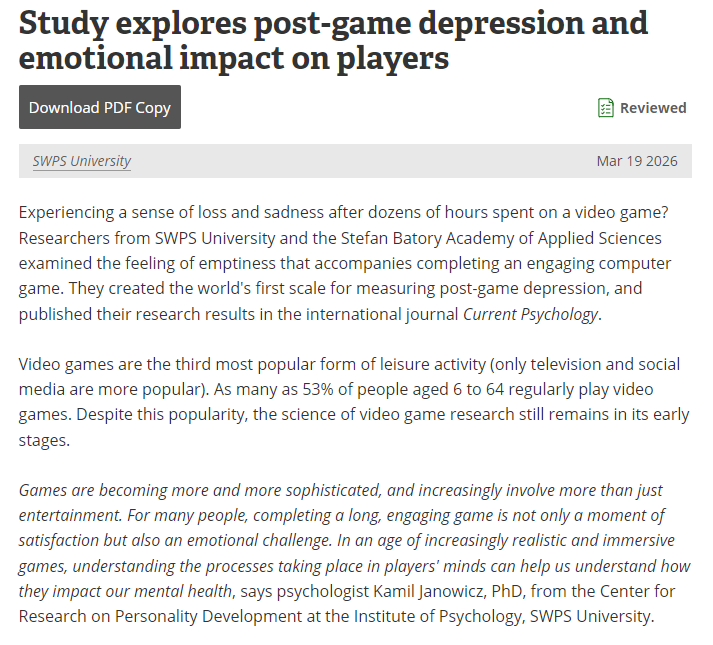
Kamil Janowicz, a psychologist at the Institute of Psychology of SWPS University in Poland, in collaboration with Piotr Klimczyk, a psychologist at Stefan Bartoli University of Applied Sciences, conducted a study of the emptiness that had struck after the end of the game. For a long time, many players have referred to the “innocence” of the game after it has been cleared, and studies have been conducted, but there has been a lack of assessment tables that would allow for quantitative studies. In response, Yanović and others developed the “P-GDS post-play depression table”, which is said to be the first global indicator to quantify post-player depression. The research team first recruited people over 18 years of age to play various games and conducted two studies on 373 players. The participants in the investigation were collected through Reddit, Discord and specific mail. Of the participants, 28.1 per cent play every day and 41.1 per cent play almost every day. 92.4 per cent of participants visit or focus on social networking sites, blogs, etc. that handle information about games. The vast majority of participants not only have game experience but also actively collect information about the game. The study identified four core factors that contribute to post-gaming depression as indicators of P-GDS. The first is “play-related reverse thinking”, i.e. reminiscent of the game; the second is “the psychological load at the end of the game”; the third is “the necessity of replaying the game”; and the fourth is “the lack of interest in the media”, i.e. the loss of interest in other media products.
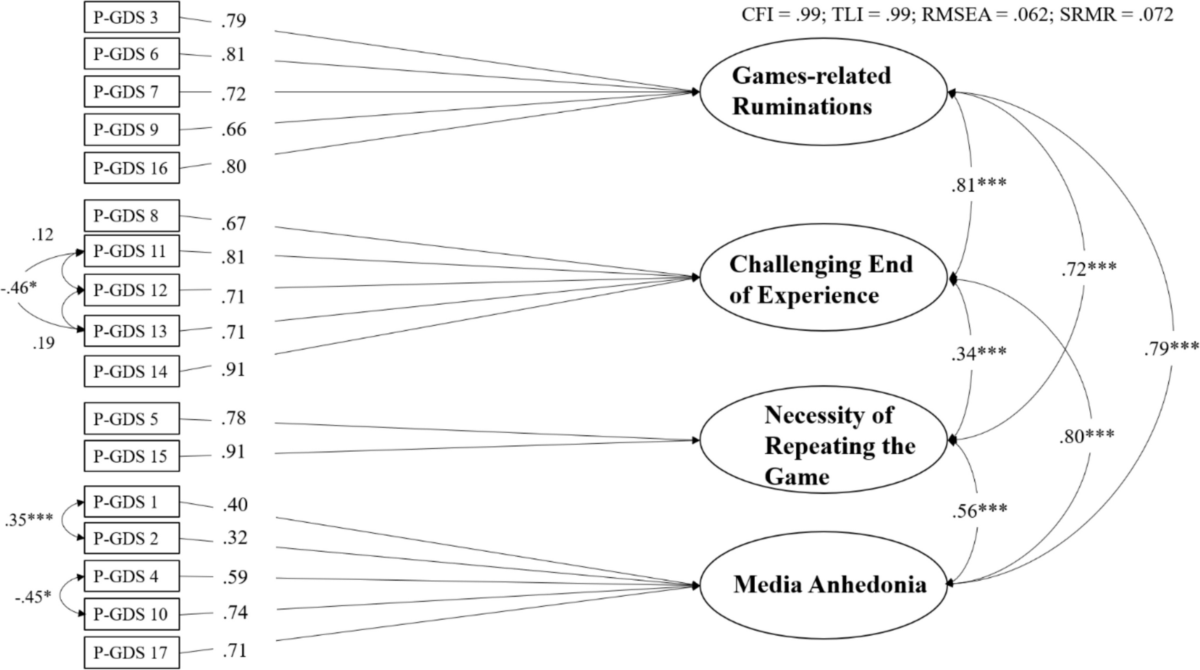
In a follow-up study, the team confirmed the structure of the above four “depressants” and measured the intensity of their impact. The results of the analysis showed that “depression after the game has been closed” is an extremely complex phenomenon and a combination of multiple, interwoven high-burden experiences. Among them, the “play-related anti-conception” has the greatest impact, while the “failure to media works” has the least impact. Researchers have also observed that even stronger sad players after the game has been cleared tend to show a tendency to view things in a pessimistic manner, thus risking a decline in the overall mental health situation. As a result, post-closure depression may be the result of the general difficulty of individual relief. The study also found that role-playing players are the most vulnerable to “electronic loss”. In this analysis, researchers believe that in the RPG game, players grow through their own decision-making roles, creating stronger emotional ties with the role. They believe that the more attractive the world of games, the more immersed, the closer the players are to the role, the more difficult it is to return to the real world when the game is over.

How many players do we have at the end of The Wild Darts 2?
“Electro-defunct” is a special defunct, similar to the departure of loved ones or the transformation of important stages of life. Psychologists stressed that for many players the virtual world has become a vital source of emotion, to the extent that it takes time and appropriate psychological tools to return to normal life. Yanović et al. indicated that the study allowed “baby after game clearance” to be quantified, not only to help study post-play emotional changes, but also to be applied in the area of game production, such as game design and marketing. Based on the P-GDS survey’s purchasing tendencies of players who have experienced “post-Customs depression”, the decision-making process of data analysers can be more dimensional. However, the study was confined to players in specific cultural circles and there was a gender bias (71.4 per cent of men). Therefore, gender differences and differences in research findings from different countries will be the subject of future research.